Understanding Lyophilised (Freeze-Dried) Peptides
"This article discusses published areas of scientific research and does not describe the intended use of any products sold on this website."
Why Are Many Research Peptides Supplied as a Powder?
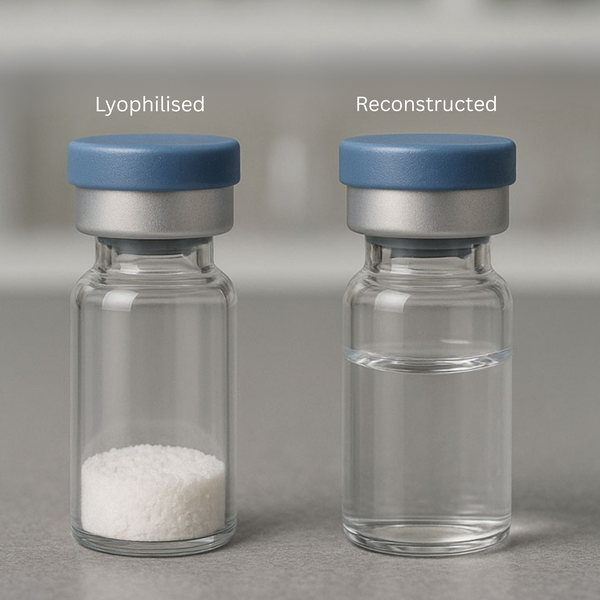
If you've explored research peptides, you've probably noticed that many are supplied as a white or off-white powder rather than a liquid. This process is known as lyophilisation, or freeze-drying, and it is widely used in scientific research to help preserve sensitive biological compounds.
Understanding why peptides are freeze-dried can help researchers and laboratories better appreciate the science behind peptide preparation and long-term stability.
What Is Lyophilisation?
Lyophilisation is a preservation process that removes water from a frozen substance under carefully controlled conditions. Instead of allowing the ice to melt into liquid water, the process causes it to change directly into water vapour through a process known as sublimation.
By removing moisture in this way, researchers can preserve delicate peptide structures while reducing the risk of degradation during storage and transport.
Why Are Peptides Freeze-Dried?
Many peptides are biologically active molecules that can be sensitive to heat, moisture, and environmental conditions. Freeze-drying is commonly used because it helps maintain the integrity of these compounds until they are prepared for laboratory research.
Researchers value lyophilised peptides because they are designed to:
Improve long-term stability
Reduce moisture exposure
Support easier storage and transport
Help preserve molecular structure
Minimise degradation over time when stored appropriately
How Does the Freeze-Drying Process Work?
The lyophilisation process generally involves three stages:
1. Freezing
The peptide solution is frozen at very low temperatures, causing the water within the solution to solidify.
2. Primary Drying
A vacuum is applied, allowing the frozen water to transition directly from ice into vapour without becoming liquid.
3. Secondary Drying
Any remaining moisture is removed, leaving behind the dry peptide powder commonly found inside research vials.
The result is a stable, freeze-dried product suitable for laboratory storage and scientific research.
Why Not Supply Peptides as Liquids?
Liquid formulations often have a shorter shelf life because water can contribute to chemical breakdown and microbial growth. By removing water during lyophilisation, researchers can improve the stability of many peptide compounds during storage and shipping.
For this reason, freeze-dried peptides are commonly preferred for laboratory and research applications.
Appearance of Lyophilised Peptides
A lyophilised peptide may appear as:
A fine white powder
A compact "cake" at the bottom of the vial
A thin layer adhered to the side of the vial
These appearances can all occur depending on the manufacturing and freeze-drying process and do not necessarily indicate differences in quality.
Storage Considerations
Proper storage is important for maintaining peptide stability in research environments. Storage recommendations can vary depending on the specific peptide, manufacturer, and intended laboratory use.
Researchers should always refer to the supplier's documentation and laboratory protocols for appropriate handling and storage practices.
Why This Matters in Research
Lyophilisation has become a widely used technique in peptide science because it helps preserve sensitive biological compounds while supporting transport, storage, and laboratory handling.
As peptide research continues to grow, freeze-dried formulations remain a standard format used by many research laboratories around the world.
Frequently Asked Questions
What does lyophilised mean?
Lyophilised means a substance has been freeze-dried to remove water while helping preserve its structure and stability.
Why are research peptides supplied as a powder?
Freeze-drying helps reduce moisture, improve stability, and support long-term storage in laboratory settings.
Is every freeze-dried peptide identical in appearance?
No. Some appear as a powder, while others form a solid cake or a thin layer inside the vial. Variations in appearance are common.
Why is freeze-drying widely used?
Freeze-drying is recognised as an effective preservation method for many sensitive biological materials because it removes water while helping maintain molecular integrity.
Research Disclaimer
This article is provided for educational and scientific information only. It discusses the laboratory preparation and preservation of research peptides and should not be interpreted as medical advice or as evidence of effectiveness for any specific purpose. Products supplied by The Velvet Dose & Co are intended strictly for laboratory, educational, and research purposes only and are not intended for human consumption or therapeutic use.


